Category Archives: Electronic Music

Crow Caw gets BFD 2!

Update 2019

This is way out of date. I upgraded to BFD3 a couple of years ago and still love the product. Very well designed software; it adheres to one of my basic software interface design rules: it should be easy to do easy things, and not to difficult to do complicated things. On top of that, I think it sounds great, there are literally thousands of grooves and fills to choose from, the filter function that allows you to choose drum pieces and drum patterns is logical and thorough, the tools for assigning grooves and drum hits to notes is great.

I haven’t really explored other drum software to this level, and for all I know they all do as much as BFD… but for my workflow and style I haven’t found anything I wished it did better.

I have an electronic kit and can play some drums, but why not let the experts do what they do best?

(Here’s the original discussion of our adoption of the BFD drum plug in)

We have used various versions of fxpansion’s BFD drum plugin product for a couple of years. Having played drums in a previous life, nothing I programmed ever quite did it for me. BFD is one of those plugins that basically is a sample playback engine with 10s of gigabytes of drum hit and drum loop and groove recordings.

The first time we tried this it was a free demo version that came in the software disc included with a copy of Computer Music magazine from a few years ago. It was a special version of BFD 1.5 but still had an amazing amount of functionality and a ton of grooves. I always wanted to buy the full version, both to support fxpansion and of course to get more!. So finally in July of 2010 I burned a candle to the gods of debt and ordered it.

[Note to software developers; yes people do steal software, but for me being able to try a well-working demo has led to a lot of purchases of good products like this one.]

It took a while to install. Depending on how impatient you are, the available space on your hard drive, or just how many velocity layers you want, the installer gives you three installation options: small, medium and large. Having just plumped for a 500GB drive I went ahead and installed the large version which takes up about 55GB.

One of the interesting features in BFD 2.1 is “load on demand”. This allows you to quickly create a part with only a few basic layers and articulations loaded, and then when you are editing the track or rendering it, the entire kit is loaded.

Overall, the sound quality and programmability of the software is superb. You can program many articulations of the more complex parts of a drum kit such as snare rim shots and various strikes on a hi hat. The internal mixer lets you select microphone locations and contributions from room, overhead, and close mics, along with plenty of signal processing and routing options.

The only complaint I have at the moment is that the GUI is awful hard to see and read due to the tiny font and dark color choices. Unfortunately, it doesn’t look like the GUI can be customized, and a post on the FXpansion support forum indicates the company is not excited about creating that possibiity. But with the use of the Magnifier accessory and a little experience, so far I’m a happy camper.

Somewhere along the line in 2010 they released 2.2 (I think 2.2.0.48 is the full number; in late 2011 they appear to be beta-ing a 2.3 version) It’s been stable enough for me that I haven’t seen much of a difference but it gives me a warm feeling. After spending actual money for it I might as well upgrade…

last modified 2011 dec

Remixing myself…

For some reason I’ve been resurrecting ancient song data files and seeing if I can still recreate them. I started with the data from Jack of Shadows, which was essentially based on MIDI files run through the Roland SC-88 and the Emu Proformance+. The sequencer used was “Metro” which was Macintosh only.
For this track (“Eaterrock”) I re-recorded the MIDI from a Roland SC-880, using it as well for the piano part. The main change is a layer on the bass organ part of a bass patch designed on an RGC Triangle II synth. This is mixed fairly low and essentially just to give a little attack to the bass part.
All the parts were soloed and then recorded as audio in Sonar 8.5.3 and mixed in the box. The other big change is instead of using the Alesis Quadraverb (which provided the reverb in the original) I used my current favorite reverb plug in, the Cakewalk Perfect Space device. (Which is basically a convolution reverb.) A company named Bricasti provided a whole bunch of free impulse responses which work fine in that device.

Below are players of the original version and the newly recorded version.

“Eaterrock” (original)
(6:09) from “Jack of Shadows”
©1995 tim p scott
https://crow-caw.com/wp-content/uploads/2010/06/tim_p_scott-0103-eaterrock_192k.mp3%20
(click (triangle) to play)
“Eaterrock” (2010 version)
(6:11) from “Songs in Work”
©2010 tim p scott
https://crow-caw.com/wp-content/uploads/2010/06/tim_p_scott-2103-eaterrock_192k.mp3%20
(click (triangle) to play)

Hmm.. on laptop speakers or earbuds, you probably won’t hear a lot of difference, especially if you listen to it in a less than perfect environment. For a limited time, then, I’m going to give links to the underlying audio tracks (192Kbps MP3s) for you to download if you like. (Depending on your browser, you should be able to just right click on the following links.)

Original Eaterrock version 2010 remixed version

Last updated 20100606

Some notes on software guitar processors

updated 2019-07-29

This is one of those posts that was halfway in the middle of being modified when I got interrupted and abandoned it. So let’s see if there’s anything salvageable in it:

sometime in 2015

Well, this is already 5 or 6 years old and there has been much progress in this field….the last version of the below was dated dec 2010.

Introduction

I’m not much of a guitar player, and the guitar I have is of equal quality. So, can using VST guitar plugins make the proverbial silk purse out of a sow’s ear? Yes and no.

Here are some notes about a few demo and freeware versions I’ve used. Your mileage will certainly vary, but at the least it may be something for you to consider.

Also remember that many of these are continually being worked on and improved, so the versions I’m writing about are probably already obsolete as you read this.

Native Instruments Guitar Rig

My collaborator pointed me at this; the best part being that the demo version (5) sounds great even though it is very limited in the number of components you can select. Somewhere along the line I found an offer for this for $99. It’s still (in 2019) my best software guitar processor.

Amplitube (version 3 or 4?)

This may have changed but this was a real ripoff because for your $200 you got one or two amp models, one cabinet, and a handful of distortion and other processors. The NI product have nearly a complete library of models and processors.

To be fair, the few modules I was able to experiment with in Amplitube did sound great.

Line 6 (www.line6.com)

I liked the POD but ultimately I couldn’t get the sounds out of it I wanted. Maybe my problem. In any case they now have a software only version, the demo is worth checking out.

Studio Devil BVC (www.studiodevil.com)

+ VST

+ Free version  for eval! (BVC variant)

+ Cheap

Pretty nasty distortion tool which can border on shrill. A little of this goes a long way.

ReValver (www.alienconnections.com)

Free versions of this commercial product can be found that have a subset of its entire feature set. This is the ultimate tweaker tool. You have a tool box full of preamp and amp models and processors you can wire together into a virtual rack, sort of like the Reason model. In each device you can actually get in and edit it as though you were actually modifying the device’s electronics. Very powerful and capable of great sounds.

Not using it so much now in 2015 since the NI Guitar Rig 5 does everything it does.

♥ Dirthead 0.80

My favorite single processor. May require a little EQ to tame the “honkiness” you can get from a cheap guitar.

  • FREE!
  • Three levels of distortion
  • “Cabinet” switch is useful and adds good sound
  • Simple to use, stable, extremely light CPU footprint
  • Did I mention FREE?!

Voxengo Tube Amp

Voxengo BoogeX

After tinkering with these a lot, it became clear that they often had one or two great characteristics, but alone didn’t do the trick. This is where Ableton’s Rack paradigm comes in handy. It’s simple to create a Rack which is a layer of several of these tools. I have Racks that parallel three or four of them, usually Dirthead, Studio Devil and Boogex. Another channel with a Live Utility device allows you to add some clean signal.

Then you can map Macro controls to easily tweak the amount of contribution to the entire sound from each device.

Then I got a job…

Hallelujah and amen. Once I managed to get an income again (not through music…that’s not ever been anything in my life)–after some research I splurged on my guitar. First I paid an expert (Moze Guitars) to set up and intonate (is that a real word?) it. I replaced the pickups with EMG active pickups at great expense…the idea was it would be much more hum resistant. Not so sure about all that.

In any case, it’s a hell of a lot more fun to play now.

I decided my trusty DigiTech RP100 was due for retirement, so after some research I ended up with the Korg Pandora PX5D. That was OK for a while. It was cool how small it was – like pocket sized. Finally I replaced it with a Line 6 Pod XT.

As of 2019 that’s gone too. I have Ableton Live and NI Guitar Rig set up for short enough latency I can actually play guitar parts in real time. But if there’s ever any problem, I bounce the arrangement without guitar to a WAV file, move that to the Zoom R8 and play through that unit’s guitar modelers. That way I don’t even need to turn on the computer to work out guitar parts.

The short story is that it’s a great little unit but since this page is supposed about software I’ll write about these things elsewhere.

Last updated 3 Dec 2010
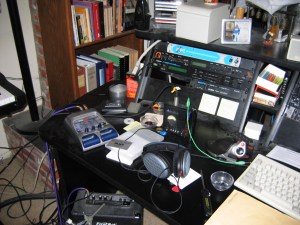
Snapshots from around the studio

Crow Caw Music Works International Headquarters

Gimme that comfy country vibe!

Guitar department - 2010

Guitar department - 2010

There’s a wealth of interesting detail here (depending on your personal understanding of the word “interesting”…) Notice the high quality $20 First Act guitar amplifier you can just see the top of under the desk. I’ve since relocated it a little bit and covered it and its mic with a heavy blanket. This seems to give me better guitar sounds…possibly because I can run it louder.

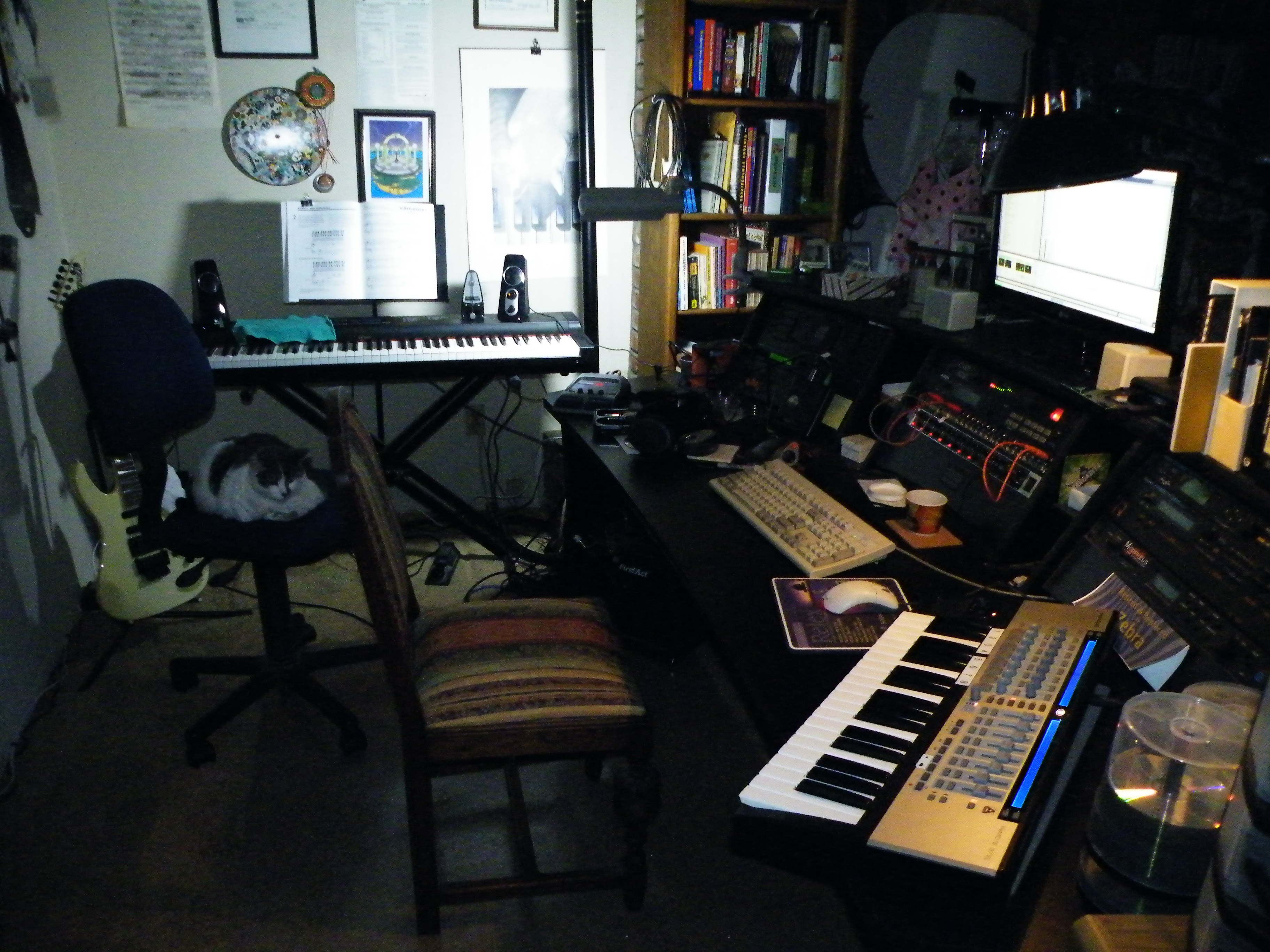
The photo below is from last fall, when I was still working on my piano lessons and the Novation Remote SL was still on the right hand side of the production desk. It’s sort of dark but you can make out one of the official CCMW Studio Cats on the task chair. When that happens I have to drag a wooden chair in to work on.

Last fall with Lucy

Welcome to the Crow Caw Music Works International Operations Center

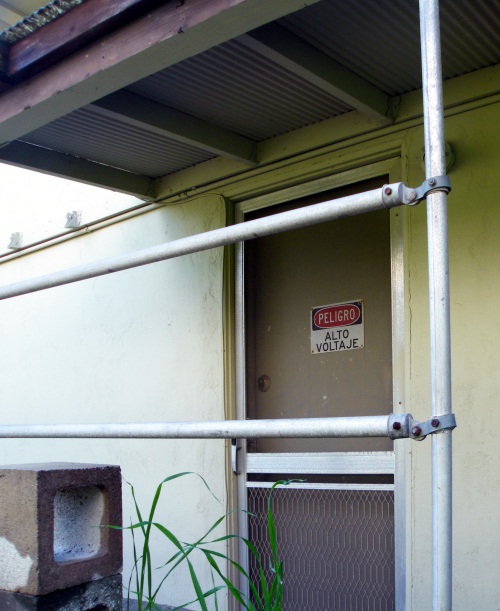
Studio front door

Is this nondescript enough?

This rather forbidding looking entrance is the front door to the CCMW IOC.The loading docks and executive towers are on the other side of the building.

Another view of the front door

As mentioned elsewhere in this site, the hardware components are inexorably being taken over by software. The main production is handled by a big computer named Colossus with lots of software editors, synths, DAWs and processors on it. A few years ago Colossus would have been state of the art (it’s based on an Intel quad-core Q6600 CPU) but now it’s “venerable.” However, it still has the juice to do what it needs to.

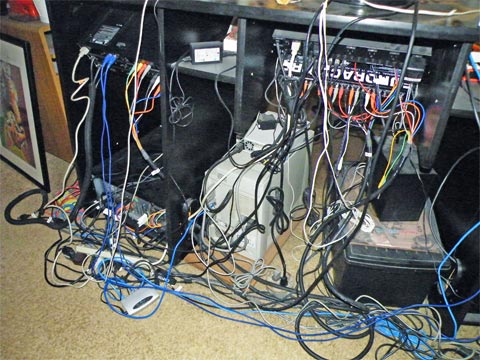
This is what the main production desk looked like from the rear. It’s been cleaned up and improved since this photo. The rack mounted Intel box is visible at the lower left. The light gray box in the middle is the retired Macintosh G3. It’s still there since once in a while we need to resurrect old project files that run in Metro or Opcode Vision that are Mac only.

From mid-2009.

Last edited 20100605

New tracks: “Whispers of Doom” and “Robot Monster 3” – technical details.

Updated 2010 02 22

I’ve just finished “mastering” two new tracks that have been in the laboratory for a few weeks.

“Whispers of Doom: is pretty much like everything else I’ve been doing lately.

“Robot Monster 3” is more fun as it uses extensive dialog samples from the 1953 grade-Z science fiction movie “Robot Monster” – see page 43 in the “Listen” section: https://crow-caw.com/40-listen/43-some-newer-tracks/

These were produced once again in Ableton Live (currently v8.1.1.) They make extensive use of the fantastic sounding Zebra2 synth — you can hear it in the bass parts and some of the leads, The venerable soft synths Triangle II and Crystal were also used, along with a weird patch from Arturia’s Analog Factory.

NWEAMO festival in San Diego – Oct 2009

Experimental Music Concert at San Diego State University

College students going tribal

College students going tribal

Joshua Fried intensely focusing on some strange thing

Joshua Fried intensely focusing on some strange thing

Joshua Fried grabbing more input from his FM boombox

Joshua Fried grabbing more input from his FM boombox

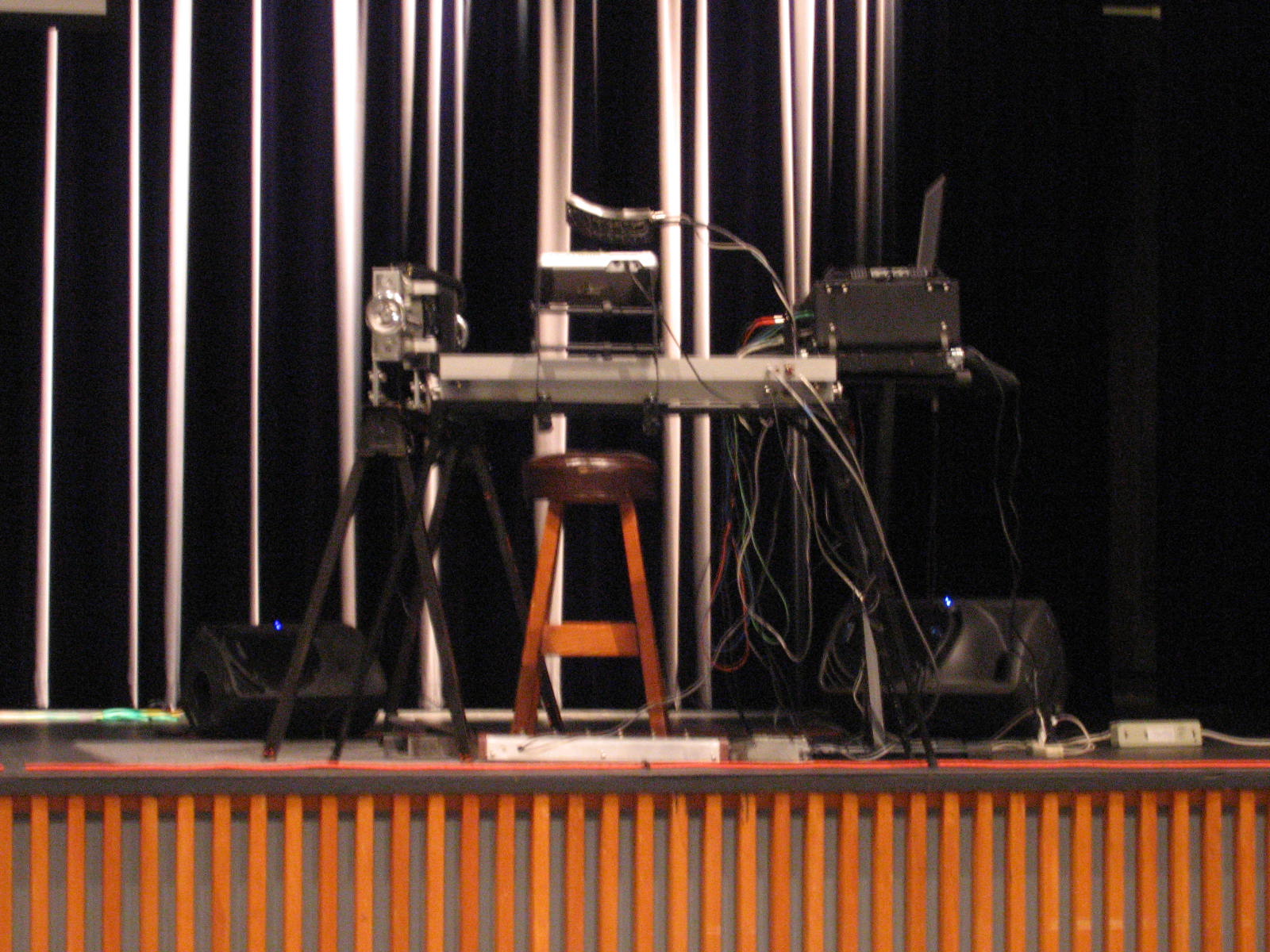
Tristan Shone's DUb Brutaliser waiting to be inflicted on the audience

Tristan Shone's Dub Brutaliser waiting to be inflicted on the audience

IMG_1703

NWEAMO is a cool organization now in its 11th year (as I understand it). Its mission is to maintain the connection between classical music and avant garde and popular. It makes sense the way they explain it. They support performances in Europe, the US and elsewhere as far as I know.

Anyway, last night was the first of two of these concerts they stage yearly in the US. Fortunately they are held at SDSU which is not far from my house.

The program was very excellent and fascinating and the only complaint I have was that it was too short! It lasted a bit under 90 minutes. In any case it was well worth it. Hopefully I’ll be able to add a bit more tonight.

There doesn’t seem to be anything recent on youtube, but do a search for NWEAMO and you can see videos from last year of previous performances in NYC and San Diego.

NWEAMO concert night; view east over the SDSU pedestrian bridge

NWEAMO concert night; view east over the SDSU pedestrian bridge

Update 4 October: I’ll go ahead and upload the snapshots I took last night. Amazing and intriguing work and a lot different than Friday’s performances.

I just wish I had some video and audio to contribute. As it was, it appears that I wasn’t really supposed to even take pictures, although I had the flash off and was careful to mute the camera.

Tristan Shone's Dub Machinery

Tristan Shone's Dub Machinery

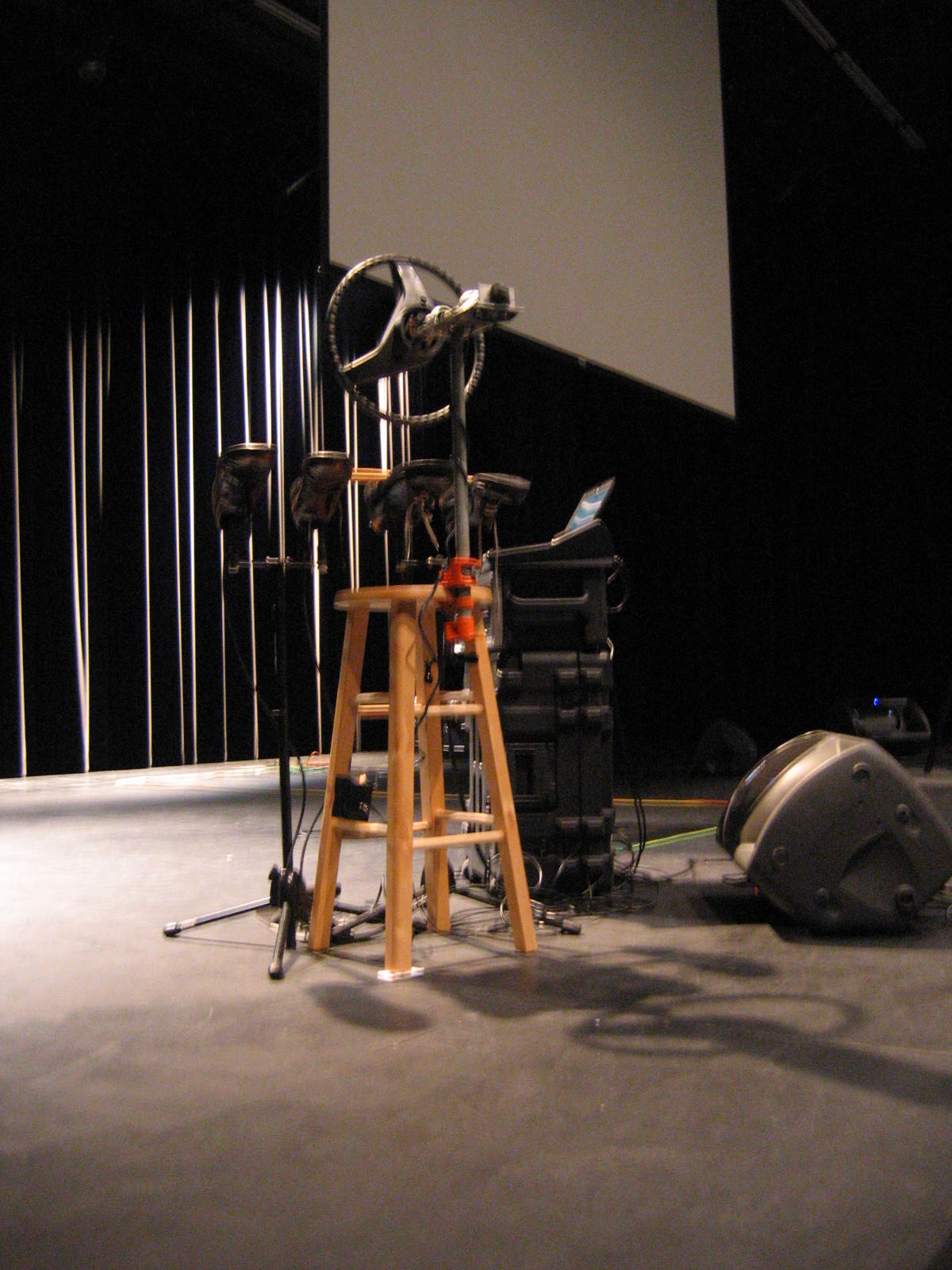
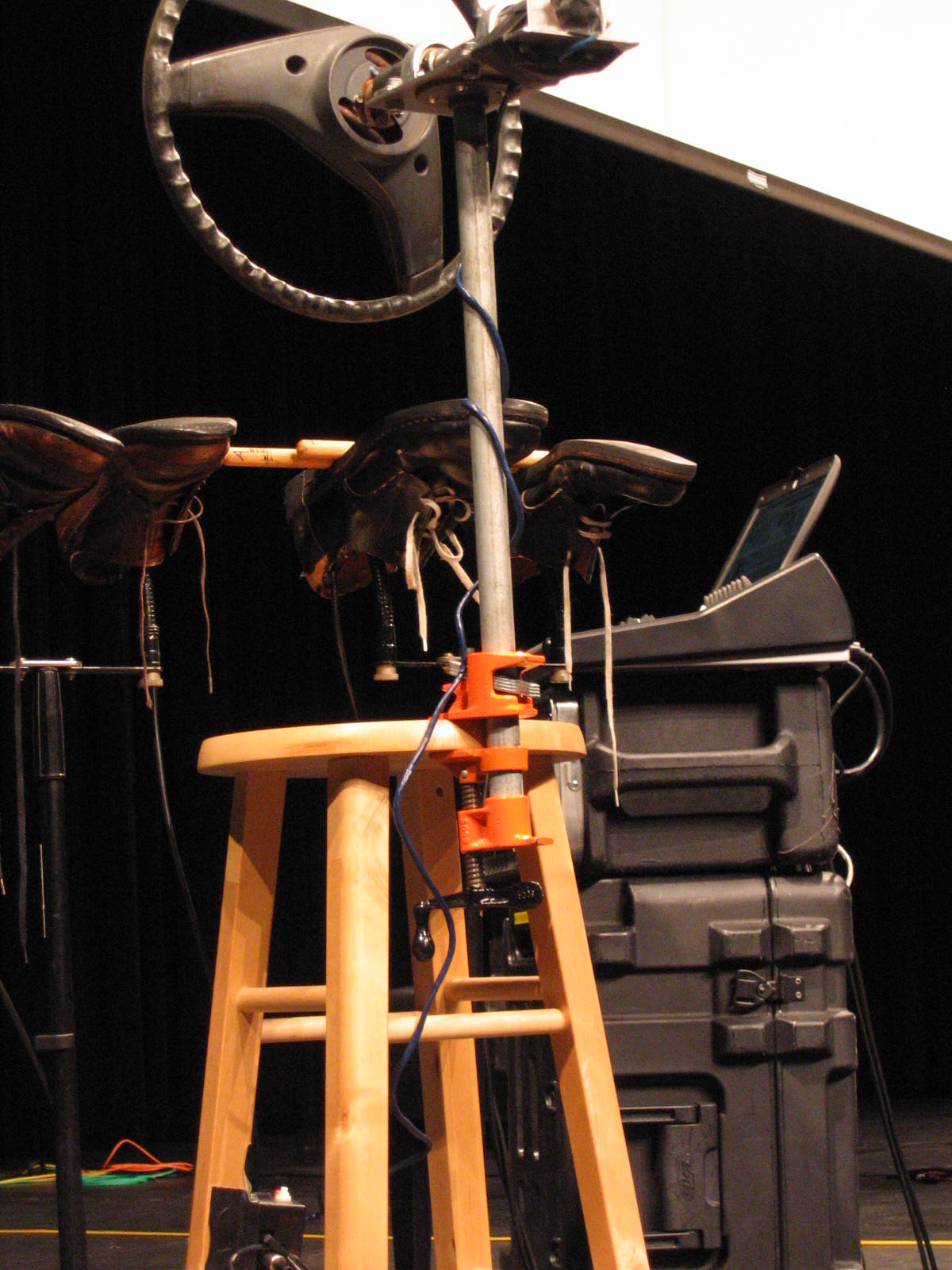
Joshua Fried's shoes, steering wheel and electronics

Joshua Fried's shoes, steering wheel and electronics

Boogieing down to Joshua's mashup

Boogieing down to Joshua's mashup

IMG_1713

Moving into the new century…

Well, not quite. As usual, I’m the last person in the world to adopt something new. In this case, I’ve finally bought a laptop.

I’ve been wanting to get a portable computer for some time. I’ve been waiting for a decent laptop under $400, but nothing was really suitable. There are Atom powered “netbooks” but I want to be able to at least run Live and Reason on it.

I saw a Turion-based system advertised at my local Fry’s store for $299. It was almost suitable, but the deal killer was the Vista Home installation. As you may know this is the version of Vista that can’t be upgraded to Windows 7 when I comes out. So I “splurged” for an Acer 5520 which is powered by a AMD Turion X2. It was another $100 but so far I think I’m glad I spent the extra money.

Then yesterday I spent another $100 on a security cable, wireless router and carry bag. It’s all good fun and now I’m another $500 in debt but happy…

Update on the laptop

Well, that turned out to be a bust. The Acer laptop was flaky beyond belief. I followed all the instructions, made sure the anti-virus and updates were all there, but after many hours of work the thing still didn’t work reliably.

I took it back to Frys which efficiently refunded my money. I ended up buying a Toshiba model which I have so far put many hours on without a single problem.

last modified 2010 sept

Where’s the new music?!

(June 26)

Well, it’s not really “NEW” but I’ve uploaded a nice copy of my Buddha Machine 2.0 remix (info on this page: https://crow-caw.com/40-listen/44-buddha-20-remix/) OK, I can announce that I have at least uploaded something new! It’s a fairly long (7:23) piece from the loops from the second version of the infamous Buddha Machine, generously provided (under a Creative Commons license) by FM3. I put the track on bandcamp for anyone’s delectation.

(May 26)

As someone once put it to me: “Life is a lot of clutter.” There are so many things you have to do that keep you from making music. And as you get older there are more and more of them. Simplify dammit!

Anyway, I also have to confess I’m tinkering too much. I have a Novation SL keyboard/control surface I really haven’t optimized for use. It’s proving worth the time for me to delve into it and the “Automap” feature.

Anyway, my new strategy is to go ahead and chunk out some partially finished tracks. Maybe at some point I’ll set up some comment strategy to see if it’s even worth pursuing a particular musical idea…

Well, stay tuned and I’ll try to update. Before that I need to fix up the CSS for this site anyway. I’m sort of getting tired of the color scheme, but I’m afraid if I change one thing I’ll have to change everything…

Warning

I’ve written about this band before. Basically it’s one of the primary influences on me and my music. Even though they only released 2 lps (that I know of) in the 1980s, I still hardly ever get tired of listening to them.
I was just making up some MP3s for my portable player, and listened to “White Camels” off the second LP (“Electric Eyes”) again, and was struck with how excellent the simple guitar lead was they used for the out…it starts at about 3:56 and goes to the end about 5:18.
I’m going to go out on a limb here again and put up the file in a player, even though it’s a frank copyright infringement. I’m justifying it by the fact the record is nearly 25 years old and most people have never heard of it. So I don’t feel I’m taking royalty money out of anyone’s bank account.

White Camels
(5:18) from “Electric Eyes”
©1982 Warning
(click > to play)

(A note about the “Possibly related posts”: WordPress seems to generate these automatically. I would personally rather they weren’t there, since it isn’t real clear that the site doesn’t put them there, and I can’t control which ones show up. So if offensive, irrelevant or ridiculous links are posted down there, apologies in advance.)